Honey Badger in Africa: Facts, Habitat, Behaviour & Unique Characteristics
Outlines
Honey Badger in Africa: Facts, Habitat, Behaviour & Why This Remarkable Animal Is So Fearless
We will tell you everything you need to know about the honey badger, also known as the ratel. Are these fascinating animals really as fearless as people say? Discover their remarkable abilities, unique behaviour, natural habitat, diet, and encounters with some of Africa's most powerful predators. We will also explore some of the most interesting facts about honey badgers and share stories of encounters with these extraordinary animals in the African wilderness.
Honey Badger (Mellivora capensis)
Who Is the Honey Badger?
Despite its name, the honey badger eats much more than honey. Also known as the ratel, this remarkable mammal is an opportunistic omnivore with a diverse diet and an impressive appetite. It belongs to the weasel family (Mustelidae) and is widely recognised for its strength, intelligence, toughness, and fearless attitude.
The honey badger has earned a reputation as one of Africa's most fearless animals. It is known for standing its ground against much larger predators and defending itself even when facing dangerous opponents.
Here are some fascinating facts about the honey badger:
-
It is widely regarded as one of the world's most fearless animals.
-
It can confront much larger animals, including lions and buffaloes, when threatened.
-
It regularly hunts venomous snakes, including cobras.
-
Its thick, loose skin provides considerable protection against bites and stings.
-
Despite its relatively short legs, it can travel long distances in search of food.
-
It has powerful front paws and long claws that make it an excellent digger.
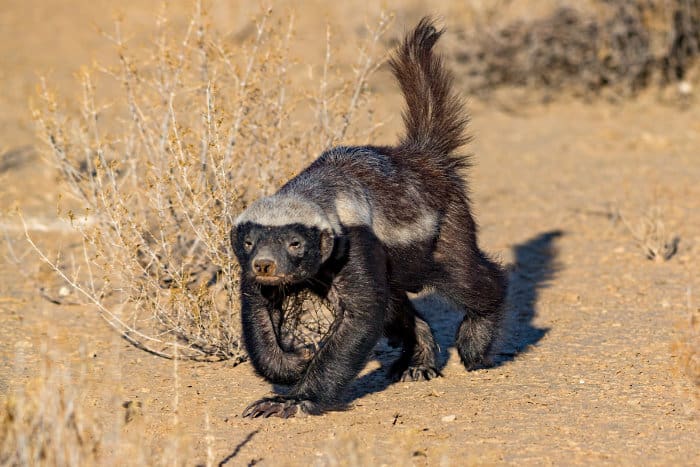
The honey badger is a terrestrial mammal with short, strong legs that inhabits a variety of environments across Africa and parts of Asia. Its distinctive appearance makes it relatively easy to recognise. Most honey badgers have a black face, sides, and lower body, while their heads, backs, and tails are covered with a contrasting greyish-white coat. Some populations also have almost entirely black individuals.
| Honey Badger Facts | Details |
|---|---|
| Common Name | Honey Badger |
| Scientific Name | Mellivora capensis |
| Animal Class | Mammalia |
| Family | Mustelidae |
| Distribution | Africa and Asia |
| Average Lifespan | 7–8 years |
| Diet | Omnivorous |
| Body Length | 55–77 cm |
| Weight | 5–16 kg |
| Conservation Status | Least Concern (IUCN) |
| Preferred Habitat | Savannas, grasslands, forests, rocky areas and mountains |
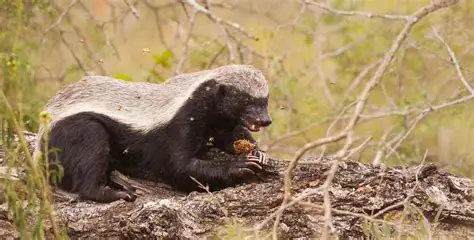
The honey badger's favourite food includes bee larvae and pupae, which it obtains by breaking into beehives. This unusual feeding behaviour is what earned the animal its common name. Although it also consumes honey, the nutritious bee larvae and pupae are particularly attractive to it.
Where Do Honey Badgers Live?
Honey badgers are found across much of sub-Saharan Africa, as well as in parts of North Africa, including Morocco, Mauritania, Mali, and Western Sahara. Outside Africa, their distribution extends into parts of Western Asia, the Middle East, and the Indian subcontinent.
They occupy a wide range of habitats, including savannas, grasslands, forests, mountains, and semi-arid regions. Their remarkable ability to adapt to different environmental conditions allows them to survive in areas with varying temperatures and food availability.
Several geographical populations and subspecies are recognised across their range, with differences in appearance and distribution.
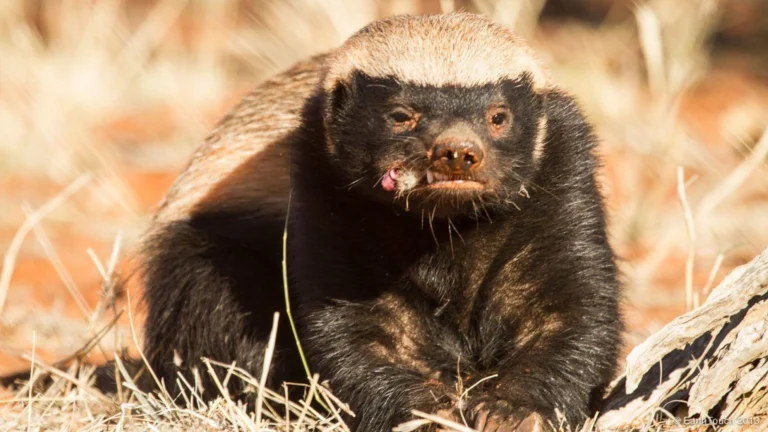
One of the honey badger's most remarkable characteristics is its fearlessness when confronted by larger animals. When threatened, it can become extremely aggressive, particularly when defending itself or its territory.
A cornered honey badger will raise its fur, expose its sharp teeth, and display its long claws. It may also hiss, growl, and release a strong unpleasant smell to discourage potential attackers. If the threat continues, it will defend itself fiercely rather than retreat easily.
Why Are Honey Badgers So Strong, Fearless and Aggressive?
The honey badger's reputation for fearlessness is supported by several remarkable physical and behavioural adaptations. Wildlife enthusiasts have long been fascinated by its ability to confront dangerous predators, hunt venomous snakes, and defend itself against animals many times its size.
But what makes this relatively small mammal so tough?
One of its greatest advantages is its exceptionally thick, loose skin. Unlike the skin of many other mammals, the honey badger's skin is remarkably flexible and difficult for predators to grip firmly. Even when caught by an attacker, it can twist and turn inside its loose skin, allowing it to face its opponent and fight back.
Its skin also provides considerable protection against bites, scratches, and porcupine quills. However, it is not completely resistant to injuries, and sufficiently powerful bites or attacks can still cause serious harm.
Another important weapon is its powerful set of front paws, equipped with long, curved claws. These claws are primarily adapted for digging, allowing honey badgers to excavate burrows, break into termite mounds, and reach prey hiding underground. However, they also become effective defensive weapons when the animal is threatened.
Their strong legs and muscular bodies allow them to dig rapidly and pursue prey over considerable distances. Combined with their sharp teeth and determined behaviour, these physical characteristics make honey badgers formidable opponents.
How Do Honey Badgers Survive Venomous Snake Bites?
Honey badgers are well known for hunting venomous snakes, including cobras and other dangerous species. Their ability to survive some venomous snake bites has attracted considerable scientific interest.
Although they are not completely immune to snake venom, honey badgers appear to have a degree of natural resistance to certain toxins.
In some documented encounters, a honey badger bitten by a venomous snake may temporarily become weak or unconscious. After resting for a period, it can recover and resume its activities.
Scientists believe that special physiological adaptations may help protect honey badgers against certain snake venoms. Similar resistance mechanisms are found in other mammals, including mongooses and some hedgehogs.
However, the exact mechanisms responsible for the honey badger's resistance are not fully understood. Not every snake bite is harmless, and sufficiently serious envenomation can still be dangerous or fatal.
The Honey Badger's Unpleasant Defence Mechanism
Another unusual defence mechanism is its ability to release a powerful, unpleasant-smelling liquid when threatened.
This liquid comes from specialised anal glands and can discourage potential attackers. The strong odour may also help the honey badger defend itself against animals that attempt to approach or attack it.
In this respect, honey badgers share a similar defensive characteristic with skunks, which are also members of the weasel family.
Are Honey Badgers Resistant to Bee Stings?
Honey badgers are famous for breaking into beehives to reach bee larvae, pupae, and honey. Their thick skin provides some protection against bee stings, making them better equipped to tolerate attacks from defensive bees.
However, they are not completely immune to bee stings. A large number of stings can still cause serious injuries or even death.
Their ability to withstand some bee attacks, combined with their determination to reach the food inside beehives, makes them particularly successful at raiding these colonies.
Overall, the honey badger shares several characteristics with its close relative, the wolverine, another member of the weasel family known for its strength, determination, and ability to confront larger animals.
Viral Video: Honey Badger Don't Care
You may have come across the famous internet video featuring a honey badger fearlessly confronting other animals. The video became one of the most popular wildlife clips online and introduced millions of people to the remarkable personality of this African mammal.
Originally filmed for National Geographic Wild, the footage became especially famous after Randall, a narrator who added humorous commentary, uploaded his version to YouTube in 2011.
The video quickly went viral, attracting more than 100 million views and becoming an internet sensation.
Viewers loved the narrator's entertaining descriptions of the honey badger's behaviour, particularly its apparent lack of concern when facing dangerous animals.
The popularity of the video also inspired a book featuring Randall's humorous commentary on wildlife, along with several advertising appearances.
The phrase "honey badger don't care" eventually became a popular expression in English. Today, people sometimes use the term "honey badger" to describe someone who is fearless, independent, determined, and seemingly unconcerned about what other people think.
Diet: What Do Honey Badgers Eat?
Honey badgers are opportunistic feeders with an exceptionally varied diet. They adapt their feeding habits according to seasonal changes, food availability, and the environment in which they live.
Although they are predominantly carnivorous, they also consume fruits, roots, berries, and other plant materials. This makes them omnivorous animals.
Their diet includes a wide variety of small animals, such as rodents, snakes, frogs, birds, and insects. They also eat bird eggs, which they can obtain by climbing trees and reaching nests.
Almost any small animal they can successfully capture may become food. Studies in the southern Kalahari Desert have recorded more than 60 species of prey consumed by honey badgers.
Some of their larger recorded prey include African wildcats, Cape foxes, bat-eared foxes, and scrub hares. They can also break open turtle shells to access the meat inside.
Honey Badgers and Venomous Snakes
One of the most fascinating aspects of the honey badger's diet is its ability to hunt venomous snakes.
Its prey includes several dangerous snake species, such as puff adders, horned adders, Cape cobras, black mambas, mole snakes, and even young or smaller African rock pythons.
Their thick skin, agility, and partial resistance to certain snake venoms provide advantages when hunting these potentially dangerous reptiles.
Honey badgers also feed on scorpions and other venomous invertebrates, demonstrating their ability to exploit food sources that many other animals avoid.
Do Honey Badgers Eat Honey?
Yes. Honey is part of their diet, but it is not their only source of food.
Their particular interest in beehives comes from the nutritious bee larvae and pupae found inside. They use their powerful claws to break open beehives and access these food sources.
They also enjoy eating other insects, including termites, beetles, and various underground invertebrates.
Do Honey Badgers Eat Plants?
Although honey badgers are primarily meat-eaters, they also consume plant-based foods.
Their diet may include roots, bulbs, berries, and fruits. In dry environments, fruits can provide an additional source of moisture when water is difficult to find.
This flexible feeding behaviour allows them to survive in different habitats and adapt to changing food availability.
How Do Honey Badgers Find Their Food?
Honey badgers have an excellent sense of smell, which helps them locate prey hidden underground.
They frequently investigate animal burrows, termite mounds, and beehives. When entering a burrow, they may use their powerful front paws to widen the entrance and reach animals hiding inside.
Their strong claws and digging abilities make it difficult for small underground animals to escape once a honey badger discovers their hiding place.
Interestingly, honey badgers generally consume their prey almost entirely, including fur, feathers, bones, and other parts that many predators leave behind.
They also occasionally feed on carrion, taking advantage of animals that have already died.
Who Poses a Threat to Honey Badgers?
Honey badgers are considered to have relatively few natural predators because of their defensive abilities and aggressive behaviour. Many larger animals prefer to avoid confronting them, particularly when they display signs of aggression.
However, they are not completely safe from predators.
Lions, leopards, hyenas, and Nile crocodiles can all pose a threat to honey badgers. Young, injured, or weakened individuals are particularly vulnerable.
Although there are reports of honey badgers escaping encounters with multiple lions and other large predators, such incidents should not be taken to mean that they can always defeat larger animals.
Humans: A Major Threat to Honey Badgers
Human activities are among the important threats facing honey badger populations in some parts of their range.
Some communities hunt honey badgers for their meat or use their body parts in traditional practices. In certain areas, people also believe that possessing parts of a honey badger can transfer its strength and courage.
Another challenge comes from beekeepers and farmers who consider honey badgers pests because they sometimes destroy beehives and raid chicken coops.
Farmers may set traps or use poison to protect their livestock and beekeeping operations. Unfortunately, these practices can result in the deaths of honey badgers and other wildlife.
Despite these local threats, the species is currently classified as Least Concern on the International Union for Conservation of Nature (IUCN) Red List.
However, populations are declining in some regions, and the species faces local conservation challenges associated with human-wildlife conflict, habitat loss, and persecution.
Natural Habitat and Behaviour: Where and How Do Honey Badgers Live?
Honey badgers are highly adaptable animals that occupy a wide variety of natural environments.
They can be found in savannas, grasslands, forests, rocky landscapes, coastal areas, and mountainous regions. Their distribution includes both dry and relatively humid environments, although they are generally absent from some lowland tropical rainforest habitats.
Because honey badgers need to search for food across large areas, they spend much of their time moving through their territories.
They are generally solitary animals, with individuals maintaining large home ranges. Males may occupy territories covering hundreds of square kilometres, depending on the availability of food and suitable habitat.
Some individuals can travel considerable distances in a single day while searching for food, shelter, and potential mates.
Although they usually live and hunt alone, honey badgers occasionally come together during the breeding season. Males and females may spend time together before mating, while females later raise their young independently.
Reproduction and Young Honey Badgers
Female honey badgers prepare a safe nesting area before giving birth. They usually dig a nursery chamber and may line it with grass or other soft materials.
After a gestation period of approximately seven to ten weeks, the female gives birth to one cub, although twins can occasionally occur.
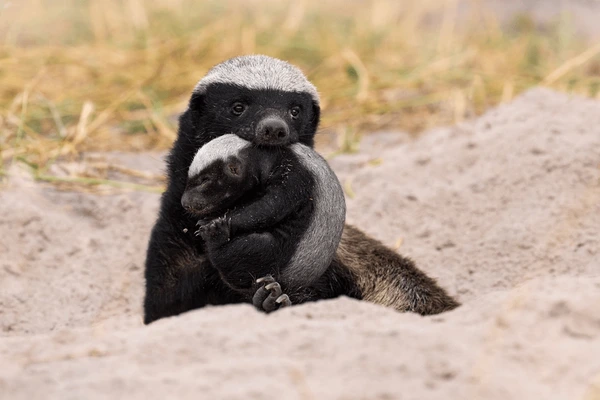
Newborn honey badgers are helpless, hairless, and blind. Their skin is delicate, and they depend entirely on their mother for protection and nourishment during their early development.
The mother raises the cub and gradually introduces it to the surrounding environment as it grows stronger and more independent.
Are Honey Badgers Nocturnal?
Honey badgers are generally nocturnal, meaning they are most active during the night. However, their activity patterns can vary depending on their location, climate, and human disturbance.
In some areas, they are also active during daylight hours, particularly when searching for food or moving through quieter environments.
This makes daytime sightings possible during an African safari, although encounters remain relatively uncommon.
Our team has experienced exactly how unpredictable these sightings can be. During a safari in Mkomazi National Park, Tanzania, we spent an entire day exploring the park's beautiful landscapes and wildlife.
After a long day of game viewing, some members of the team became tired and decided to close their eyes for a few minutes inside the safari vehicle.
Unfortunately, that was precisely when a honey badger appeared and crossed the road.
"Honey badger!" the driver shouted excitedly.
But the animal disappeared into the surrounding vegetation almost immediately. Those who had closed their eyes missed a rare opportunity to see one of Africa's most fascinating mammals.
It was a moment that reminded us that wildlife encounters are unpredictable, and sometimes the most extraordinary sightings happen when you least expect them.
Because honey badgers patrol large territories, they often use several different resting places rather than returning to the same shelter every night.
Honey Badger Homes
Honey badgers are excellent diggers and use their powerful front claws to create underground shelters.
A typical honey badger burrow consists of a tunnel that can extend several metres into the ground, providing a relatively safe place to rest and escape from potential threats.
However, they do not always dig their own homes. Honey badgers are opportunistic when it comes to finding shelter and frequently occupy abandoned burrows created by other animals.
These may include burrows originally dug by aardvarks, foxes, mongooses, and warthogs. They may also use vacant termite mounds when suitable opportunities arise.
In rocky environments, honey badgers can find shelter inside natural crevices and small caves. Tree hollows may also provide suitable resting places.
Their ability to use different types of shelters is another example of how adaptable these animals are.
Honey Badgers in Tanzania
Tanzania is home to a remarkable variety of wildlife, including the elusive honey badger. Although sightings are relatively uncommon, these animals inhabit several natural environments across the country.
They can be found in different national parks and protected areas where suitable habitats and food sources are available.
Some of Tanzania's wildlife destinations offer opportunities to explore landscapes inhabited by honey badgers, including Mkomazi National Park and the forests surrounding Mount Kilimanjaro.
Their secretive behaviour and mostly nocturnal activity make them difficult to encounter during ordinary game drives. Nevertheless, patient wildlife enthusiasts may occasionally be rewarded with a sighting.
How Nano Africa Safaris Connects With Africa's Wildlife
At Nano Africa Safaris, our passion for wildlife and the natural beauty of Tanzania inspires us to introduce travellers to some of Africa's most extraordinary animals and landscapes.
Tanzania is one of East Africa's leading safari destinations, famous for its spectacular national parks, diverse ecosystems, and incredible wildlife populations.
We organise safari experiences to some of the country's most celebrated destinations, including Serengeti National Park, Ngorongoro Conservation Area, Tarangire National Park, and other remarkable wildlife destinations.
Our goal is to help travellers experience the beauty of African nature through unforgettable wildlife encounters, cultural experiences, and carefully planned safari adventures.
Beyond wildlife safaris, Tanzania is also home to Mount Kilimanjaro, Africa's highest mountain, offering extraordinary trekking experiences for travellers seeking adventure.
Whether exploring the endless plains of the Serengeti or discovering the wildlife-rich landscapes of northern Tanzania, every safari offers an opportunity to appreciate the incredible diversity of African nature.
Where Else Can You Find the Honey Badger as a Symbol?
The honey badger's reputation for courage, strength, and determination has made it an interesting symbol beyond the African wilderness.
Its image and name have been adopted by different organisations, sports teams, and public figures who admire its fearless character.
In Canada, for example, the Brampton Honey Badgers basketball team competes in the Canadian Elite Basketball League. The team adopted the animal's name and incorporated its image into its branding. The Brampton Honey Badgers won the league championship in 2022.
Interestingly, honey badgers are not native to Canada, making the team's choice of mascot even more distinctive.
Several well-known athletes have also earned the nickname "Honey Badger" because of their determination and aggressive sporting styles.
These include Australian rugby player Nick Cummins, Formula One driver Daniel Ricciardo, Canadian ice hockey player Brad Marchand, and American football player Tyrann Mathieu.
The nickname reflects the characteristics associated with the animal: toughness, persistence, courage, and the willingness to face difficult challenges.
The honey badger has therefore become more than just an African mammal. It is also a symbol of determination and resilience recognised in different parts of the world.
How to See Wild Honey Badgers in Their Natural Habitat
If you want to see a honey badger in the wild, visiting one of Tanzania's national parks is an excellent place to begin.
However, it is important to understand that honey badger sightings are relatively rare. These animals are secretive, generally solitary, and often active at night, making them more difficult to spot than elephants, giraffes, zebras, and other commonly seen safari animals.
Mkomazi National Park and other suitable wildlife habitats in Tanzania offer opportunities to explore environments where honey badgers occur.
The best approach is to enjoy a safari with an experienced guide who understands animal behaviour and can help identify signs of wildlife activity.
Even if you do not encounter a honey badger, Tanzania's national parks offer countless opportunities to see other fascinating African animals in their natural habitats.
With Nano Africa Safaris, you can explore Tanzania's spectacular wilderness and experience the unforgettable beauty of African wildlife.
Who knows? You might be lucky enough to encounter one of Africa's most remarkable and elusive mammals during your safari.
Frequently Asked Questions About Honey Badgers
Is a honey badger aggressive?
Honey badgers can be extremely aggressive when threatened, cornered, or defending themselves. They are known for confronting much larger animals, although they generally prefer to avoid unnecessary encounters with humans.
Why are honey badgers so tough?
Honey badgers have several physical adaptations that make them exceptionally tough. These include thick, loose skin, powerful legs, strong jaws, and long claws. They also have a degree of natural resistance to certain snake venoms.
Why are honey badgers considered fearless?
Their reputation for fearlessness comes from their willingness to defend themselves against much larger predators. Their physical strength, protective skin, sharp claws, and determined behaviour allow them to confront dangerous situations.
Is it safe to touch or keep a honey badger as a pet?
No. Honey badgers are wild animals with powerful jaws, sharp teeth, and strong claws. They can cause serious injuries when threatened and are not suitable as domestic pets. It is always best to observe them from a safe distance in their natural habitat.
Do honey badgers only eat honey?
No. Despite their name, honey badgers have a varied diet. They eat bee larvae, insects, rodents, snakes, birds, eggs, frogs, scorpions, fruits, roots, and other available food sources.
Can honey badgers kill lions?
Honey badgers are capable of defending themselves against lions, but they cannot reliably defeat such large predators. Their thick skin, claws, and aggressive behaviour may discourage an attack, but lions remain capable of killing them.
Are honey badgers immune to snake venom?
No. Honey badgers are not completely immune to snake venom, although they appear to have natural resistance to certain toxins. A serious venomous bite can still cause severe injury or death.
Where do honey badgers live?
Honey badgers are found across much of sub-Saharan Africa and parts of North Africa and Asia. They inhabit savannas, grasslands, forests, rocky areas, and mountainous environments.
Are honey badgers found in Tanzania?
Yes. Honey badgers occur in Tanzania and inhabit various natural environments, including protected wildlife areas. They are relatively difficult to spot because of their secretive behaviour and largely nocturnal habits.
What animals are related to honey badgers?
Honey badgers belong to the Mustelidae family, which includes several other carnivorous mammals. Their relatives include wolverines, otters, weasels, ferrets, martens, and badgers. Despite their similar appearance, mongooses belong to a different mammalian family.
Explore Blogs